![LOUD[FRAMED]](https://loudframed.eu/wp-content/uploads/2026/08/LOUDFRAMED_logo_dark.png)
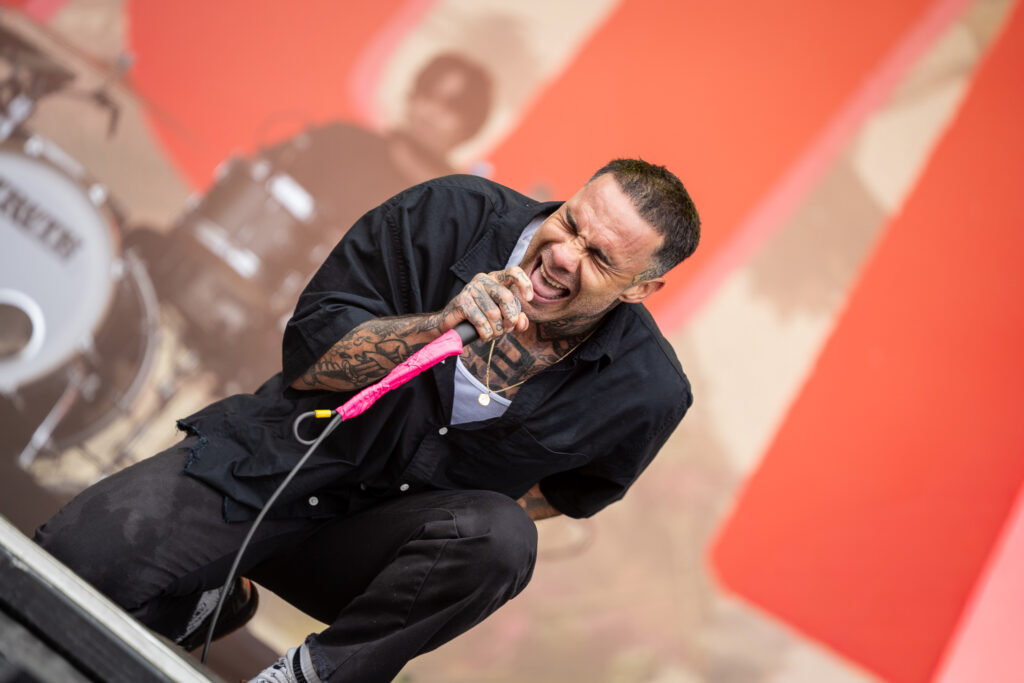
Rock am Ring | Nürburgring, Germany | 5–7 June 2026
Rock am Ring is too big to experience in full. That is part of both its appeal and its problem. Multiple stages, tens of thousands of people and a line-up stretching from hardcore and modern metal to alternative rock, punk and some of the biggest names in heavy music mean every day becomes a series of choices.
Our route through the 2026 edition leaned firmly towards the heavier and alternative side of the program. Across three days at the Nürburgring, that meant everything from DRAIN and LETLIVE. to Linkin Park, Iron Maiden and The Offspring, with plenty happening between those extremes.
DAY ONE [FRAMED] | Hardcore, riffs and a very big ending
Friday started relatively small and ended about as far from small as Rock am Ring gets. Loathe and DRAIN represented two very different sides of the contemporary heavy scene, while Mastodon and Architects gradually increased the scale before Limp Bizkit and Linkin Park took over the Ring.
Loathe
Loathe have become one of the more interesting British heavy bands precisely because they refuse to settle into one sound. Crushing guitars can suddenly give way to atmospheric passages, with metalcore, alternative metal and shoegaze all occupying the same space without feeling stitched together.
That contrast works particularly well live. The quieter sections create room around the heaviness rather than slowing it down, and when the guitars return they hit harder because of it. At Rock am Ring, Loathe provided an early glimpse of modern heavy music that is increasingly comfortable looking beyond traditional genre boundaries.
We Came As Romans
We Came As Romans brought a more direct form of modern metalcore. Years of touring have turned them into a dependable live band, but there is still an emotional weight underneath the polished production that prevents the performance becoming routine.
Their material is built around the contrast between melody and impact, a familiar metalcore formula that only works when both sides are convincing. Here they were. Big choruses gave the crowd something to hold onto before the heavier sections opened things back up again.
Slay Squad
Slay Squad were one of Friday’s more confrontational propositions. Their mix of deathcore, hardcore and hip-hop influences is deliberately abrasive, with little interest in fitting neatly into the traditional metal festival framework around them.
That made their presence useful. At a festival where huge productions can easily dominate the conversation, bands operating closer to the underground provide some necessary friction. Slay Squad sounded raw, aggressive and considerably less interested in making things comfortable.
Ankor
Ankor continued the day’s modern-metal thread but approached it from another direction. Electronic elements, melody and heavy guitars give the band a contemporary sound that sits comfortably alongside the current European metalcore and alternative scene.
Their Rock am Ring appearance also showed why festival slots below the biggest names still matter. These are the stages where bands can move from online recognition and support tours towards becoming part of the wider festival circuit. Ankor looked comfortable taking that step.
Mastodon
Mastodon require a different kind of attention. Their music has always moved between sludge, progressive metal and increasingly expansive songwriting, and that complexity does not disappear simply because the songs are being played on a festival stage.
What does change is the scale. Riffs that can feel dense on record become enormous outdoors, while the band’s musicianship remains central without turning the show into an exercise in technical display. Against a Friday increasingly moving towards arena-sized performances, Mastodon brought weight without needing spectacle to manufacture it.
Bush
Bush provided a connection to another era of alternative rock without feeling completely dependent on it. Gavin Rossdale remains an energetic frontman, and the band’s strongest songs have survived well beyond the decade in which they first became unavoidable.
There is inevitably nostalgia attached to seeing Bush at a festival in 2026, but nostalgia alone does not keep a field interested. The songs still need to work. Enough of them do, and their set offered a useful shift away from the increasingly heavy direction of the rest of our Friday.
Architects
Architects now operate on a scale far removed from the clubs and smaller stages that formed their early years. Their current live production is designed for arenas and major festivals, combining precision, lighting and songs written to reach well beyond the front rows.
Yet their presence at Rock am Ring still connects directly to the heavier scenes represented elsewhere on the bill. That history gives their growth some context. Architects have not simply appeared at this level. They have spent years moving towards it, and their performance showed a band entirely comfortable with where they have arrived.
DRAIN
DRAIN brought something Rock am Ring needs more than another enormous production: hardcore chaos.
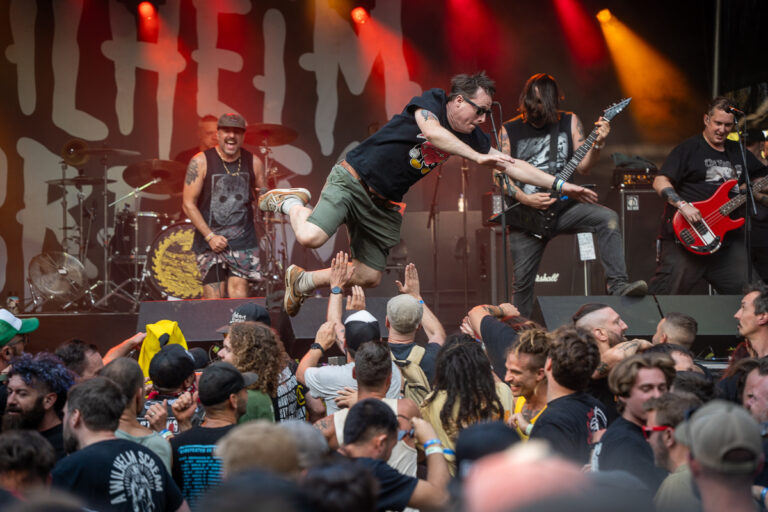
Sammy Ciaramitaro treats the barrier between performer and audience as an inconvenience rather than a rule, and the band’s crossover-heavy hardcore is built around participation. The result felt refreshingly physical in a festival environment where many performances are necessarily separated from the audience by scale.
DRAIN are also a good example of how far contemporary hardcore can travel without sanding away everything that made it exciting in smaller rooms. The stage may get bigger. The basic objective remains the same: get people moving.
Limp Bizkit
Few bands can turn questionable taste into a festival advantage quite like Limp Bizkit. Decades after nu-metal became one of rock’s favourite targets, Fred Durst and company have somehow emerged on the other side with their catalogue not only intact, but embraced by another generation.
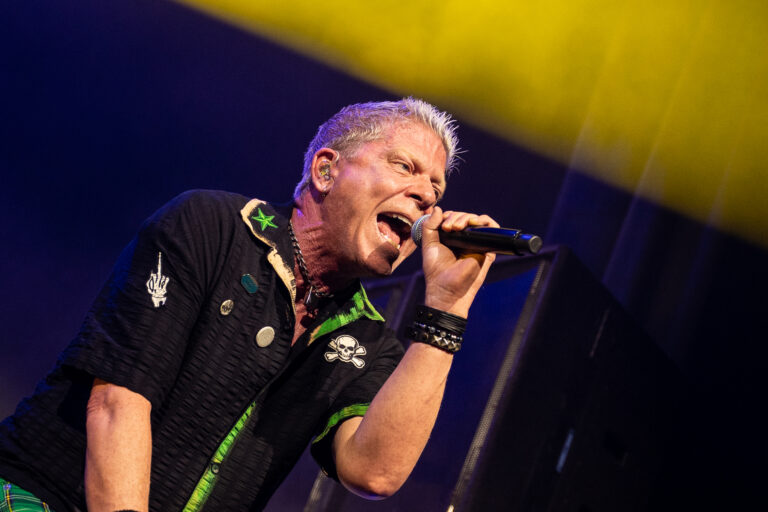
At Rock am Ring, irony quickly became irrelevant. The riffs are immediately recognisable, Durst understands exactly how to work a crowd of this size and songs once treated as relics of the early 2000s now trigger enormous reactions. Whatever argument people once had about Limp Bizkit, the live show settled it in the simplest possible way: the crowd had a very good time.
Linkin Park
Linkin Park carried a different weight. Their return has inevitably been surrounded by discussion about what the band can and should be after the death of Chester Bennington, but a festival headline show eventually has to move beyond that conversation and function on its own terms.
At Rock am Ring, the scale of the catalogue was impossible to ignore. Songs that have lived with people for more than two decades met a band entering a fundamentally different chapter, with Emily Armstrong now standing at the front of that change. It was not an attempt to recreate an earlier version of Linkin Park. Nor could it be. Instead, the set showed a band trying to move forward while carrying one of modern rock’s most recognisable catalogues with them.
DAY TWO [FRAMED] | No single version of heavy
Saturday was perhaps the clearest demonstration of how broad Rock am Ring has become. LETLIVE. and Wargasm could share a day with Tom Morello, The Pretty Reckless, Electric Callboy and Volbeat without any of them feeling completely misplaced.
Ecca Vandal
Ecca Vandal opened our Saturday with a collision of punk, alternative rock and electronic influences. There is a restless quality to her music that makes straightforward categorisation fairly pointless, and that translated into a performance with considerably more personality than a conventional early festival slot.
For LOUD[FRAMED], these are often the interesting bookings. Not because they necessarily pull the largest crowd, but because they sit between established scenes rather than safely inside one of them. Ecca Vandal brought exactly that kind of energy to Saturday.
LETLIVE.
LETLIVE. have never been a band to stand still and play the songs politely. Their return has restored one of post-hardcore’s most unpredictable live acts to festival stages, with Jason Aalon Butler once again treating the available space as something to be challenged.
There is substance underneath the chaos. LETLIVE.’s music has always combined post-hardcore aggression with soul, punk and social commentary, and the physical nature of the performance works because the songs can support it. At Rock am Ring, they were a reminder of how much a festival gains when a show feels genuinely capable of going off-script.
The Pretty Reckless
The Pretty Reckless brought Saturday towards darker, blues-influenced hard rock. Taylor Momsen’s voice remains the obvious focal point, but the band’s strength is that the material around it has enough weight to prevent the performance becoming a vehicle for the vocalist alone.
Their set occupied a more traditional rock space than much of our weekend, but that was hardly a disadvantage. Rock am Ring’s history has always included bands that sit somewhere between alternative rock, metal and mainstream hard rock, and The Pretty Reckless fit comfortably into that lineage.
Tom Morello
There are guitarists whose sound is recognisable before the song itself. Tom Morello is one of them.
His work with Rage Against the Machine permanently changed expectations of what a guitar could do inside heavy rock, but his influence extends beyond effects pedals and unconventional technique. Politics, protest and the idea that heavy music can be explicitly connected to the world outside the festival gates remain part of the package.
At the Nürburgring, that history gave the performance more weight than a collection of familiar riffs. Morello remains a musician with something to say and a very distinctive way of saying it.
Wargasm
Wargasm brought Saturday sharply back into the present. The British duo mix nu-metal, industrial noise, punk and electronic music with little concern for where one ends and another begins.
Sam Matlock and Milkie Way make that collision work through sheer live energy. Their shows feel confrontational without becoming calculated, and at a festival containing several generations of alternative music, Wargasm represented what happens when younger bands inherit all of those influences at once and see no reason to keep them separated.
Ice Nine Kills
Ice Nine Kills approach a festival stage with a very different set of priorities. Horror imagery, costumes and theatrical set pieces are not decoration around the songs. They are part of the show itself.
That can easily become gimmicky when the music underneath is not strong enough. Ice Nine Kills have avoided that problem by building a modern metalcore catalogue capable of carrying the production. At Rock am Ring, the result was closer to a compact horror show than a conventional festival set, but the riffs still did enough work when the props were removed from the equation.
Electric Callboy
Few bands make the collision between metalcore and deliberately ridiculous party music look as natural as Electric Callboy.
The German band’s rise has been remarkable, but it makes sense when seen from inside a festival crowd. Breakdowns, electronic hooks, costume changes and absurd humour turn the performance into something designed for collective participation rather than serious inspection. They know exactly what they are doing, and more importantly, the audience does too.
Rock am Ring is an ideal environment for it. Electric Callboy can retain enough heaviness for the metal crowd while delivering the kind of spectacle that works all the way to the back of a huge field.
Volbeat
Volbeat closed our Saturday from a considerably more established position. Their combination of heavy metal, rock ‘n’ roll and rockabilly has become instantly recognisable, particularly across the European festival circuit.
There are few surprises involved, but that is not necessarily criticism. Volbeat know how to headline a major rock festival, Michael Poulsen knows how to carry a crowd and the songs have been tested on stages of this size for years. After a day that jumped repeatedly between scenes and styles, Volbeat provided a straightforward, muscular ending.
DAY THREE [FRAMED] | Punk history meets metal history
By Sunday, the weekend had already covered a ridiculous amount of musical ground. The final day still found room for Bad Nerves, Social Distortion and The Offspring alongside TesseracT, Breaking Benjamin, Alter Bridge, Sabaton and Iron Maiden.
Bad Nerves
Bad Nerves started our Sunday at speed. Their short, sharp songs pull from punk and power pop without wasting much time getting to the chorus, an approach particularly useful when waking up a festival crowd on day three.
There is a looseness to their performance that cuts through the machinery surrounding a festival the size of Rock am Ring. No huge concept required. Just fast songs, movement and enough melody to make them stick.
Black Veil Brides
Black Veil Brides occupy an unusual position between metal, hard rock and the alternative culture that surrounded their rise. Their visual identity once attracted almost as much discussion as the music, but longevity has gradually made that debate less relevant.
At Rock am Ring, the focus was on a band with enough catalogue and stage experience to comfortably handle a major festival. Big choruses and an unapologetically theatrical approach remain part of the formula, but the performance itself has long since grown beyond the early scene labels attached to them.
Hollywood Undead
Hollywood Undead brought rap-rock and nu-metal back into Sunday’s mix. Their multi-vocalist approach and combination of electronic elements, hip-hop and heavy guitars belong to a strand of alternative music that has proved considerably harder to kill than many expected.
Festival crowds are particularly forgiving of genre boundaries when the songs are familiar and the energy is right. Hollywood Undead understand that well. Their set was less about purity and more about getting a tired Sunday crowd involved again.
Breaking Benjamin
Breaking Benjamin are a much rarer sight on European stages than their status in North America might suggest. That alone gave their Rock am Ring appearance additional interest.
Their dark, melodic alternative metal has produced a catalogue built for large venues, but European audiences have had fewer opportunities to experience it live. At the Nürburgring, songs that have spent years travelling across the Atlantic through headphones finally had the scale around them that they were written for.
TesseracT
TesseracT brought precision back into Sunday. Their progressive metal depends on rhythm, atmosphere and control rather than constant aggression, making them a very different proposition from many of the weekend’s heavier bands.
The impressive part is how well that detail survives a festival environment. Complex music can easily disappear outdoors, particularly when audiences are tired and distractions are everywhere. TesseracT held attention by allowing the songs to breathe instead of trying to compete with the festival around them.
Social Distortion
Social Distortion brought decades of punk history to the Nürburgring without needing to behave like a heritage act.
Mike Ness and company have always occupied their own corner of punk, mixing rock ‘n’ roll, country influences and street-level storytelling into a sound that has aged differently from many of their contemporaries. It is less frantic than much of the punk heard across the weekend, but carries a different kind of weight.
Seeing them on the same day as The Offspring also made the generational thread difficult to miss. California punk has travelled in many directions. Sunday provided more than one chapter of that story.
Alter Bridge
Alter Bridge are built for stages of this size. Mark Tremonti’s guitar work gives the band its metallic edge, while Myles Kennedy has the kind of voice capable of carrying melodic hard rock across a festival field without needing much assistance.
Their performance did not depend on surprise. Instead, it relied on musicianship, songs and years of experience in front of large crowds. At the end of a weekend packed with theatrical productions and genre collisions, that straightforward confidence was effective.
The Offspring
The Offspring occupy an unusual position in punk. Their biggest songs have become part of mainstream rock culture, yet the speed, humour and melodic instincts that carried them out of the Southern California punk scene remain immediately recognisable.
That history becomes particularly visible at a festival. Different generations know the same choruses for completely different reasons, and the response spreads far beyond people who would describe themselves as punk fans. The Offspring did not need to fight for Sunday’s attention. Decades of songs had already done that work.
Iron Maiden
Then came Iron Maiden.
There is little useful left to say about their importance to heavy metal that has not been written many times before. What matters at a festival is whether that history still becomes something tangible once the lights go down.
It does.
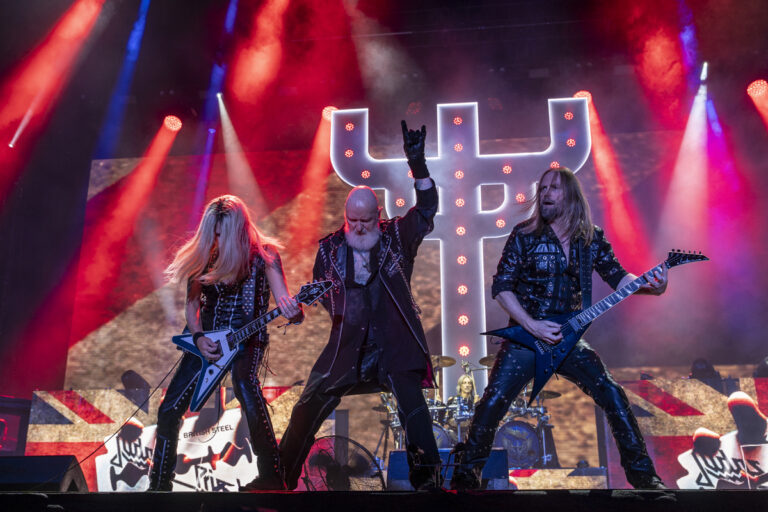
Bruce Dickinson still treats a festival stage as territory to be conquered, Steve Harris remains the engine underneath the band and the visual production operates on the scale expected from one of metal’s defining institutions. Yet beneath Eddie, the lights and decades of mythology are songs that continue to hold enormous crowds together.
Rock am Ring spends much of its weekend showing where alternative and heavy music are going.
Iron Maiden are part of the reason there was a road to travel in the first place.
Sabaton
Sabaton had the difficult task of existing in the orbit of one of heavy metal’s biggest institutions, but subtlety has never been their preferred solution.
Their military-history-driven power metal is designed for spectacle: huge choruses, coordinated production and enough firepower to make even a major festival stage feel busy. The formula divides opinion, but its effectiveness in front of a large European festival audience is difficult to dispute.
By the final hours of Sunday, spectacle was exactly what Rock am Ring was offering.
THE [FRAMED] VIEW
Trying to reduce Rock am Ring 2026 to one version of rock music would be pointless.
Across three days, DRAIN and LETLIVE. showed why hardcore and post-hardcore still benefit from unpredictability. Loathe, Architects, Wargasm and TesseracT demonstrated several completely different directions modern heavy music can take. Social Distortion and The Offspring connected the weekend to generations of punk, while Mastodon, Alter Bridge and Volbeat occupied their own corners of the heavier rock spectrum.
Then there were the bands whose histories extend beyond the weekend itself. Linkin Park returned in a new form while carrying songs tied deeply to a previous one. Limp Bizkit showed just how dramatically perceptions of nu-metal have shifted. Tom Morello brought riffs that helped change alternative heavy music, and Iron Maiden stood at the other end of the timeline with more than four decades of metal history behind them.
That range is Rock am Ring’s biggest strength.
It can also be exhausting. Distances are large, clashes are inevitable and experiencing the festival means accepting that another interesting band is probably playing somewhere else at exactly the same time. You do not really complete Rock am Ring. You choose your route through it. Ours went from emerging bands and hardcore pits to some of the largest productions in heavy music.
Three days around the Ring, and no single definition of what a rock festival is supposed to sound like.